
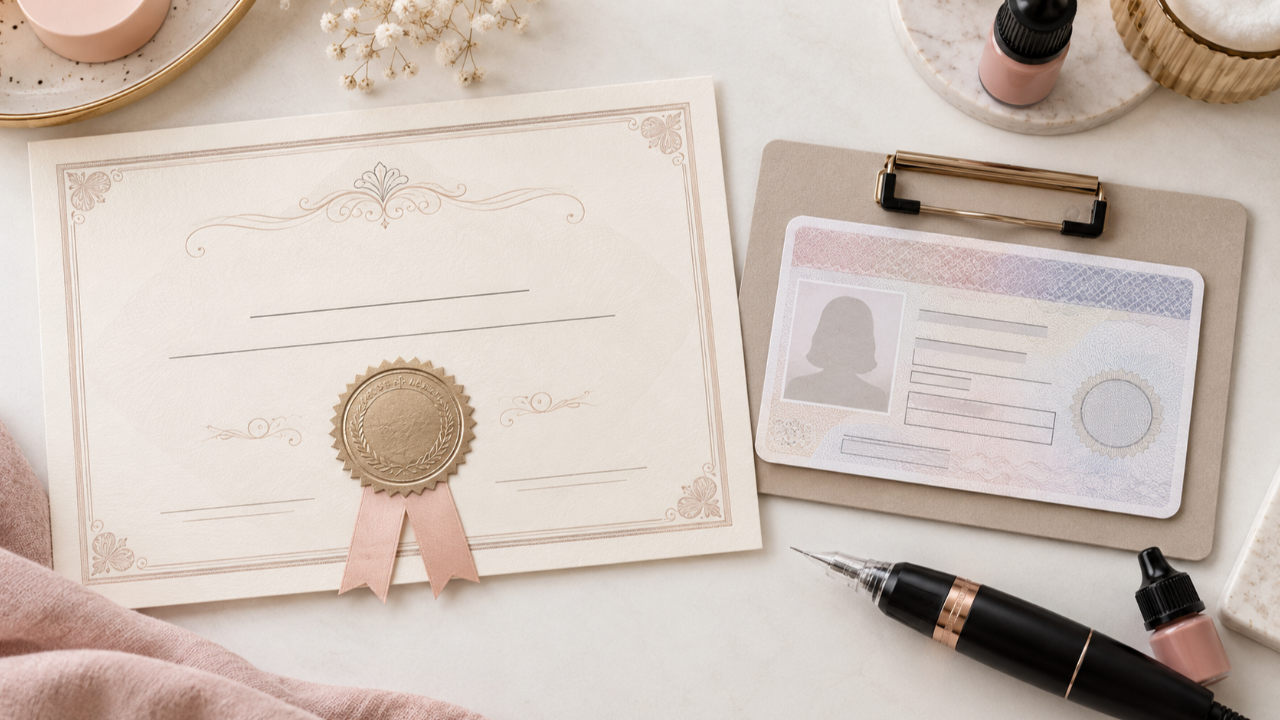
PMU Certification vs Licensing: What's the Difference?
Oct 08, 2026You finish the course, complete the assessment, and receive your certificate. That is an accomplishment. But does it mean you are legally ready to take permanent makeup clients?
Not automatically.
This is where a lot of new artists get confused. Permanent makeup certification and licensing are often talked about as if they are the same thing, but they answer two different questions.
- Certification asks: What training did you complete, and what did that training provider require you to demonstrate?
- Licensing asks: What does the government authority where you practice require before you can legally perform the service?
Let me say this plainly: your certificate and your legal permission to work are not the same piece of paper. You may need both, and depending on where you live, the legal document may not even be called a license.
What is Permanent Makeup Certification?
A permanent makeup certification usually comes from a school, trainer, academy, or education provider. It documents that you completed a particular course or program. Depending on the provider, you may also need to pass quizzes, submit an assessment, complete model work, or meet another standard before the certificate is issued.
The word certified can sound universal, but the requirements behind it are not always the same. One certificate may confirm attendance. Another may confirm course completion. Another may show that your work was reviewed. Before you enroll, ask exactly what you must complete and what the certificate will state.
A certificate can be valuable. It can document your education, may support an insurance or local application, and shows that you invested in learning a specific subject. What it cannot do on its own is override the rules where you plan to work.
What is PMU Licensing?
Licensing is the word people use most often, but your regulator may call the requirement a license, permit, registration, credential, body art card, or something else. It is issued or required by a government authority, not by your course instructor.
The authority may regulate you as an individual, the facility where you work, or both. It may also require separate documentation for sanitation training, blood borne pathogen education, an apprenticeship, supervised practice, inspections, zoning, or business operation.
Do not get stuck on the label. Your job is to find out what legal authorization applies to your service and your exact work address.
Permanent Makeup Certification and Licensing Compared
|
Question |
Certification |
Licensing or local authorization |
|
Who issues it? |
A school, trainer, academy, or other education provider. |
A state, county, city, health district, licensing board, or other government authority. |
|
What does it show? |
That you completed the provider's stated training or assessment requirements. |
That you or your facility met the legal requirements attached to that credential. |
|
Is it the same everywhere? |
No. Course length, assessment, model work, and certificate language vary. |
No. The name, agency, training, experience, facility, and renewal rules vary by jurisdiction. |
|
Does it authorize client work? |
Not by itself. |
It may be part of the legal authorization to practice, but you must confirm every applicable requirement. |
|
Can one replace the other? |
No. |
No. A regulator can still require proof of qualifying education or other documentation. |
Why the Answer Changes by Location
Permanent makeup is a form of tattooing, and the FDA explains that the actual practice of tattooing is regulated by local jurisdictions. That is why there is no single permanent makeup license that works everywhere in the United States.
Look at how different two locations can be. Texas requires businesses that perform permanent cosmetics to license as tattoo studios. In Southern Nevada, permanent makeup artists need the appropriate Body Art Card, while the Health District also permits and inspects body art establishments. Southern Nevada also uses apprentice and mentor cards for artists who do not yet meet the experience requirement for a permanent card.
Those examples are not a checklist for your state. They are proof that you cannot assume the rules in one city apply to another. Even moving across a county line or renting a room in a different facility can change which agency and approval process applies.
Do You Need Both a Certificate and a License?
You may. A regulator, employer, insurance carrier, or facility may ask for proof of education in addition to whatever government credential applies. But the exact combination depends on where and how you work.
I want you to separate the questions instead of searching for one document that does everything:
- What does my training provider require before issuing a certificate?
- What does my regulator require before I perform permanent makeup?
- What does the facility need before PMU services can be offered there?
- What does my insurer require for the services I plan to provide?
- Do any rules apply specifically to microblading, machine work, advanced procedures, or model work?
When you answer each question separately, the path becomes much easier to understand.
What Else May Be Required Before You Take Clients?
A permanent makeup certification may be only one item in your compliance file. Depending on your location and business setup, you may need to verify requirements in several categories.
- Artist authorization, such as a license, registration, permit, or body art card
- Facility approval, studio licensing, inspections, or plan review
- Bloodborne pathogen or infection-control training
- Apprenticeship, supervised hours, mentorship, or documented experience
- Business licensing, zoning, insurance, and recordkeeping
- Consent, age, sanitation, sharps, waste, and aftercare requirements
Not every item applies everywhere.
Does an Esthetics or Cosmetology License Cover PMU?
Do not assume it does. Permanent makeup may be regulated under tattooing or body art rather than under the beauty license you already hold. In another location, a cosmetology or esthetics board may still be part of the process.
Ask the agency directly whether your current credential covers the exact service you want to perform. Use the words permanent makeup, cosmetic tattooing, and microblading when you ask, because agencies do not always organize the information under the term PMU.
Can You Get Permanent Makeup Certification Online?
You can complete valuable permanent makeup education online, especially theory that you need time to study and revisit. Color theory, pigment behavior, needles, machines, skin, consultation, healing, and procedure concepts all benefit from focused education.
But an online certificate still means what that specific provider says it means. It does not automatically satisfy your local licensing rules, and it does not replace hands-on training when hands-on education, supervised practice, or model work is required.
Before buying an online course, compare the curriculum and certificate requirements with the rules where you plan to practice. You want the education to strengthen your path, nor discover afterward that you were researching the wrong credential.
How to Verify Your PMU Requirements
Do this before you book models, sign a lease, or advertise appointments.
- Start with the exact address where you plan to work. State rules may not be the only rules. Your county, city, or health district may regulate the artist or facility.
- Find the agency that regulates tattooing or body art. Search official government websites and contact the agency when the language is unclear.
- Name the exact service. Ask about permanent makeup, cosmetic tattooing, microblading, powder brows, eyeliner, lips, and any paramedical service you plan to offer.
- Separate artist requirements from facility requirements. Renting a room inside an existing business does not automatically mean the location is approved for PMU.
- Ask what proof of training is accepted. Find out whether the agency requires a particular number of hours, hands-on instruction, apprenticeship, exam, assessment, or trainer qualification.
- Get the answer in writing. Save the official page, email, application, renewal date, and contact information. Rules change, and you may need the documentation later.
- Recheck before you move or add a service. A credential that covered one location or procedure may not transfer automatically.
What to Ask Before Choosing a Certification Course
Do not stop at, "Will I be certified?" That question is too broad. Ask:
- Is this a certificate of attendance, completion, or assessed competency?
- What must I complete before the certificate is issued?
- Does the course include hands-on training or require prior hands-on education?
- Does the curriculum match the education my local regulator requires?
- Will I receive documentation showing the course topics, hours, trainer, and completion date if needed?
- What support is available when I begin applying the education to real cases?
A responsible course provider can tell you what its certificate represents. It cannot promise that one certificate makes you legal in every state, county, or country.
Where Girlz Ink Academy Fits
Girlz Ink Academy's paid courses include a certificate of completion. That certificate documents the education you completed with the Academy. It is not presented as a national license or a replacement for the rules where you work.
If you are new to PMU, begin by checking your local requirements. Then use education to build the knowledge behind the service. Girlz Ink's foundational courses cover color theory, needles, machines, and movement so you can understand more than a memorized procedure. Procedural online courses are designed to complement appropriate hands-on training, not replace it.
That is the difference I want you to remember; education helps prepare you to do the work. Licensing, registration, permits, or cards determine whether your location allows you to do it. Take both seriously.
Licensing rules can change. This blog provides general education information, not legal advice. Verify current requirements with the agencies governing the exact location where you plan to work.
Frequently Asked Questions
Is permanent makeup certification the same as a license?
No. A permanent makeup certification or course certificate documents training completed under a provider's requirements. A license, permit, registration, or body art card comes from the government authority regulating your work location.
Can I work after receiving a PMU certificate?
Only if you have also met every requirement that applies where you plan to work. The certificate alone does not automatically authorize you to take clients.
Do all states require a permanent makeup license?
Rules and terminology vary. Some jurisdictions license an individual artist, some regulate or license the facility, and others use permits, registrations, body art cards, apprenticeships, or a combination. Check both state and local agencies.
Does an online PMU course count toward certification?
An online course can issue the certificate described by that provider. Whether it satisfies a regulator's education requirement depends on the jurisdiction, the course format, and what the agency accepts.
Do I need a cosmetology or esthetics license for permanent makeup?
That depends on where you practice. Do not assume an existing beauty license covers cosmetic tattooing. Ask the agency regulating permanent makeup at your exact work location.
What should a permanent makeup certificate show?
Useful documentation may include your name, course title, provider or trainer, completion date, and the requirements completed. If your regulator requires specific hours or topics, ask whether the provider can document them.
Where do I check PMU licensing requirements?
Start with official state and local government sources. Look for the agency regulating tattooing, body art, environmental health, or occupational licensing, then confirm artist and facility requirements in writing.

